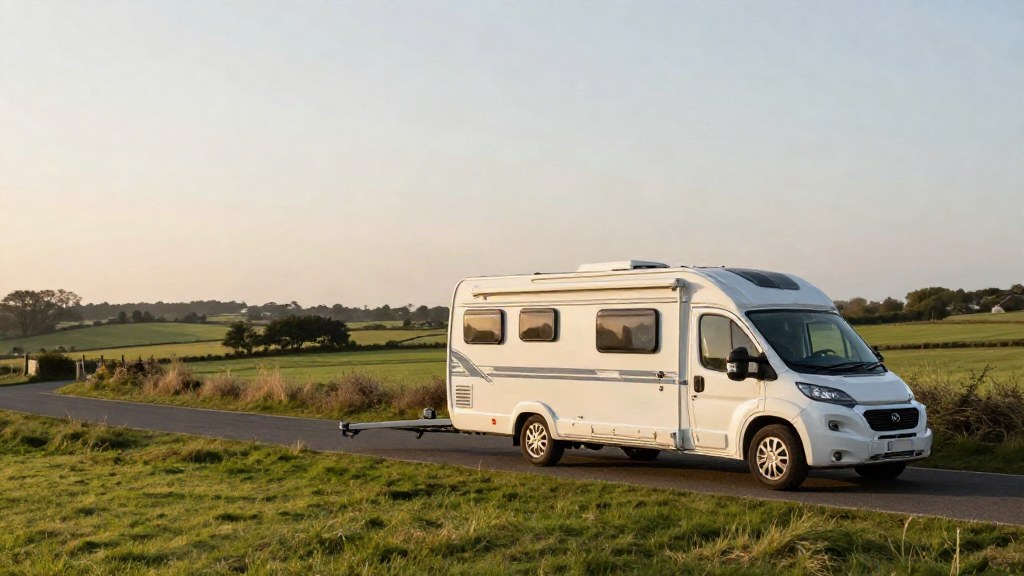
You have the car, you have the caravan, and you have a pitch booked somewhere green and quiet. Before you hitch up, there are a handful of numbers worth knowing. Get them right and your first tow will feel steady, legal and far less nerve-racking. Get them wrong and you will know all about it on the first hill.
None of this is complicated once you know what each number means. This guide walks through the weights that matter, how to work out a sensible towing ratio, and why the figures you enter into your sat nav genuinely change the drive ahead of you.
The numbers that matter: kerbweight, MTPLM, nose weight and payload
Kerbweight is what your car weighs with a full tank of fuel and no luggage, passengers or tow bar load. You will find it in the car handbook or on the vehicle plate. It is the figure you compare your caravan against.
MTPLM stands for Maximum Technically Permissible Laden Mass - the heaviest your caravan is allowed to be once it is fully loaded. Next to it you will usually see MIRO, the Mass in Running Order, which is roughly the caravan as it came out of the factory. The gap between MIRO and MTPLM is your payload.
Payload is everything you add: gas bottles, battery, water, awning, clothes, food, the folding chairs and that spare kettle. It adds up quicker than most people expect, so weigh your load rather than guessing.
Nose weight is the downward force the caravan puts on the tow ball. Too little and the outfit can feel twitchy; too much and you overload the car's rear. Both your car and your caravan will state a maximum nose weight - work to the lower of the two.
Finally, the caravan towing weight ratio. It is simply your caravan's actual laden weight expressed as a percentage of your car's kerbweight. A ratio of 85% means the caravan weighs 85% of what the car does.
How to work out a sensible towing ratio
The maths is easy. Take your caravan's laden weight (aim for the MTPLM as your worst case), divide it by your car's kerbweight, then multiply by 100. A 1,300kg caravan behind a 1,600kg car gives you 1,300 ÷ 1,600 x 100, which is around 81%.
As a rule of thumb, 85% is the figure many first-time towers aim for, with experienced drivers comfortable closer to 100%. This is guidance rather than law, but a lower ratio generally means a more stable, forgiving outfit - especially in crosswinds, on motorways and when a lorry passes you.
The hard limits are legal ones and worth checking carefully. Your car has a maximum towing weight, your caravan has an MTPLM, and your driving licence category affects what you are allowed to tow. Licence rules changed in recent years, so confirm the current position on GOV.UK before you rely on it.
Load the caravan sensibly too. Put heavy items low down and over the axle, keep the weight balanced side to side, and avoid piling things up at the very back, which can set up a sway. If in doubt, take a trip to a public weighbridge - it is cheap, quick and settles the argument.
Why accurate weights feed into route planning and stop choices
Weight is not just a safety number - it is a navigating number. Once you know your real laden weight and dimensions, you can plan a route that suits the outfit rather than the car alone. That means steering clear of weight-restricted bridges and lanes, avoiding roads with sharp climbs where a heavy trailer will slow you right down, and choosing stops with enough room to turn and park up without a three-point shuffle in front of an audience.
It helps on arrival, too. A heavier van takes more care to get level, and knowing your figures makes it easier to pick a pitch that suits the outfit rather than hoping for the best when you pull in.
This is exactly where a purpose-built app earns its keep. The Motorhome & Caravan Sat Nav app is designed for UK touring: enter your vehicle's dimensions and weight, find your next stop among 6,000+ UK campsites, and navigate with live traffic and Apple CarPlay. It is free for 7 days, then GBP 3.99 a month on iPhone and iPad.
A quick pre-hitch checklist
Check the car's kerbweight and maximum towing limit, confirm the caravan's MTPLM, and work out your ratio before you load up. Weigh the nose weight with a gauge once the van is loaded, aiming for the lower of the car and caravan limits. Check your licence covers the outfit, keep heavy kit over the axle, and set your tyre pressures for towing.
Then put your figures into your sat nav so the route and stops match the van you are actually pulling.
The bottom line
Matching your car to your caravan is a ten-minute job with a calculator and a handbook, and it pays off every single mile. Know your kerbweight, MTPLM, payload and nose weight, aim for a sensible towing ratio, and let accurate numbers guide where you go next. Do that and you can get on with the good bit - the open road, the quiet pitch and the kettle going on.